The Porsche Market Reality Check: Listening Before It’s Too Late
February 16, 2026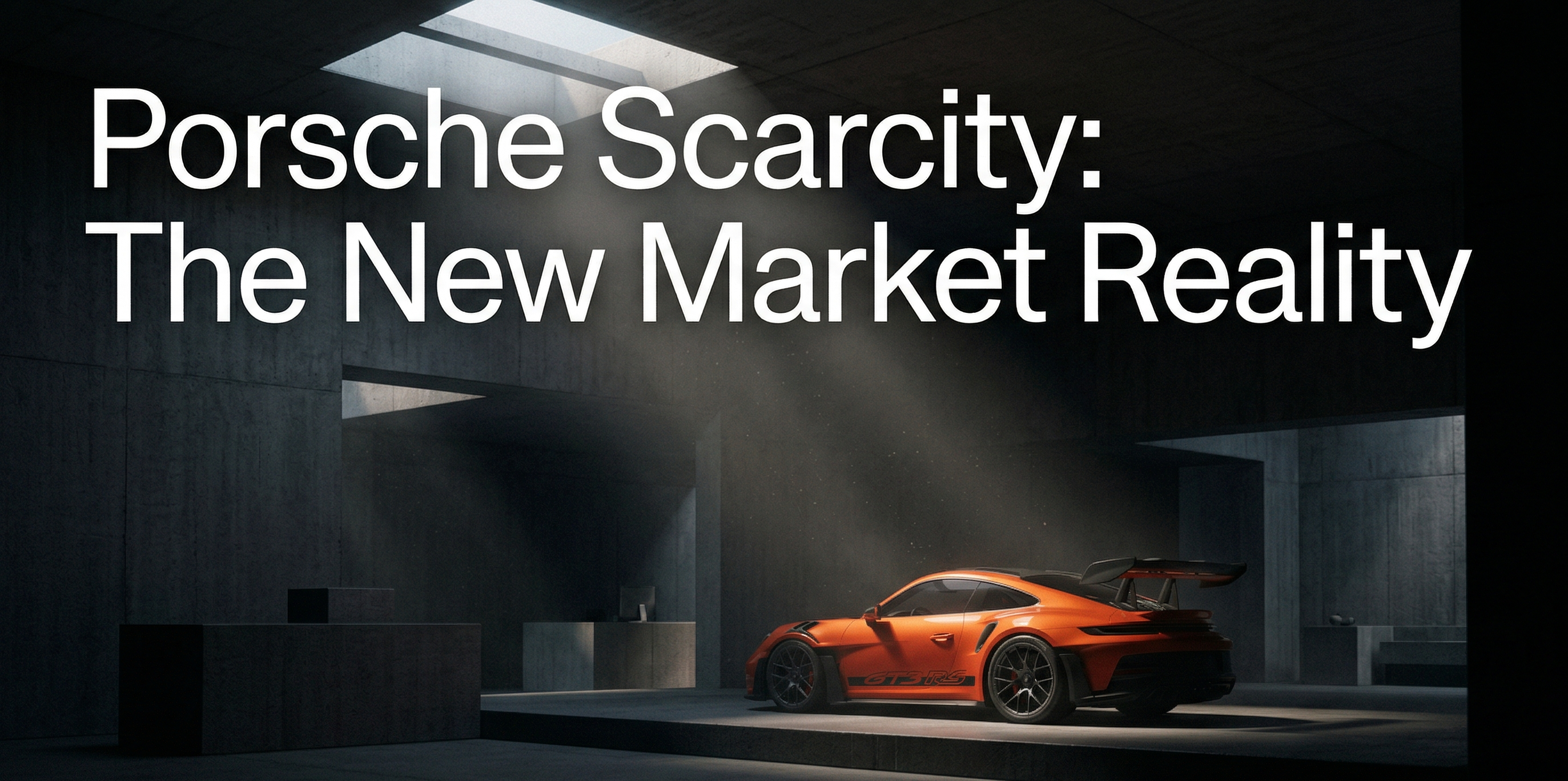
Scarcityand Selling Smart: A Porsche Market Reality Check
April 1, 2026
If you think the Porsche market has “slowed down,” you’re looking at the wrong cars. What’s actually happening in 2026 is far more nuanced and far more dangerous for anyone relying on outdated assumptions.
This Isn’t a Weak Market. It’s a Filtered One.
Let’s get straight to it.
The Porsche market hasn’t collapsed. It hasn’t softened as many expected.
What it has done is sharpen.
The noise around economic pressure, electrification, and broader automotive uncertainty is real. But on the ground, where deals actually happen, the picture is very different:
Serious buyers are still buying. Proper cars are still selling.
And the best examples are becoming increasingly difficult to access.
The shift is behavioural, not structural.
Buyers are calmer, more forensic, and far less willing to compromise. That single change is quietly reshaping the entire market.
This Is No Longer a “Find One and Buy It” Market
A lot of buyers are still operating with a 2021 mindset. Scroll, spot, enquire, buy.
That approach now gets you one of two outcomes:
You either miss the right car entirely, or
You end up owning the wrong one for longer than you planned.
Because here’s the reality in 2026:
The wrong car sits.
The right car disappears.
And the gap between those two outcomes is widening. This is now a precision market. Not a volume one.
You’re not just “buying a Porsche” anymore. You’re selecting a very specific asset within a very selective pool.
That requires judgment. Timing. And access that isn’t always visible publicly.
Supply Hasn’t Dried Up. Quality Has.
There are still plenty of cars listed. That’s not the issue.
The issue is how few of them actually matter. What we’re seeing consistently:
Owners of genuinely well-specced, well-maintained cars are holding them longer. The number of standout examples coming to market is thinning.
Competition for clean, properly curated cars is increasing quietly, not loudly.
And crucially, many of the best cars never properly “launch” to the open market. They’re placed.
Introduced.
Offered discreetly.
Sold before the wider audience even knows they exist.
If you’re only looking at public listings, you’re seeing a filtered version of reality and often not the top tier of it.
Sellers: Strong Position, But Only If You’re Honest
If you own a good Porsche, you are in a strong position.
But only if you understand what“good” actually means in this market. Demand is very clearly focused on:
Clean ownership stories
Strong, desirable factory specification
Proper maintenance and documented provenance
Where sellers are going wrong is assuming that demand is universal. It isn’t.
Average cars are being exposed. Optimistically priced cars are being ignored. Poorly presented cars are being punished.
The market is rewarding precision and quietly rejecting everything else. So the question isn’t“is it a good time to sell?” It’s“Is your car one of the ones the market actually wants?”
The Quiet Driver of 2026: Finance Strategy
One of the more interesting shifts, and one that isn’t being talked about enough, is the rolefinance is now playing in decision making.
Buyers aren’t just evaluating cars. They’re evaluating exposure. Questions we’re hearing more frequently:
What’s my downside here?
How flexible is my position if the market moves? Am I buying the car, or structuring the risk?
This is a significant change.
Because when finance is structured correctly, it does three things:
Reduces perceived risk, opens access to better cars
Allows buyers to act faster when the right opportunity appears
In a selective market, speed and confidence matter. Finance is now part of that equation, not an afterthought.
The Gap in the Market Is Where the Advantage Sits
What all of this creates is a gap.
On one side, you have visible inventory and reactive buyers.
On the other hand, you have informed operators working with access, timing, and intent.
That gap is where the best outcomes are happening. It’s where the right cars are sourced.
Where deals are structured properly.
And where mistakes are avoided before they become expensive.
What This Means If You’re Buying
If you’re entering the market now, understand this:
You likely have more leverage than you think. But you also have less margin for error.
The best cars are not always publicly available. The obvious choice is not always the right one.
And waiting for “certainty” often means missing the opportunity entirely.
This is a market that rewards clarity and decisiveness, not hesitation.
What This Means If You’re Selling
If you’re selling, the opportunity is still very real. But the execution matters more than ever. Pricing needs to reflect reality, not optimism.
Presentation needs to match the level of the car.
And most importantly, your car needs to be seen by the right buyers, not just more buyers.
Because in this market, exposure without targeting doesn’t create results. It just creates friction.
Final Thought: Porsche Hasn’t Changed. The Market Around It Has.
Porsche ownership has always been emotional.
But buying and selling them has become increasingly strategic. In 2026, the winners aren’t the fastest or the loudest.
They’re the most informed.
They’re the ones who understand that this isn’t a broken market. It’s a selective one.
And if you know how to read it properly, it’s still full of opportunity.
Key Takeaways
The Porsche market in 2026 is selective, not weak
Buyer behaviour has become more strategic and less emotional. The gap between average and exceptional cars is widening
Many of the best cars are traded in the market
Sellers must be precise with pricing and positioning. Finance is playing a bigger role in buying decisions
Access, timing, and experience now define outcomes
FAQs
Is the Porsche market slowing down in 2026?
Not in the way headlines suggest. Transaction activity remains strong for high-quality cars. What has slowed is the demand for average or poorly specified examples.
Are Porsche prices dropping?
Some segments are softening, particularly for less desirable specifications. However, well- specced, low-owner cars with strong provenance are holdingfirmand in some cases becoming harder to replace.
Why are good Porsche examples harder to find?
Owners of the best cars are holding them longer, and many desirable cars are sold privately before reaching public listings.
Is it a good time to buy a Porsche?
Yes, if you approach it correctly. Buyers have leverage, but success depends on selecting the right car and acting decisively when it appears.
Is it a good time to sell a Porsche?
It can be, particularly if your car has a strong specification and history. However, pricing and presentation are critical in today’s selective market.
How important is specification in the current market?
More important than ever. Specification, history, and condition are now the primary drivers of demand and liquidity.