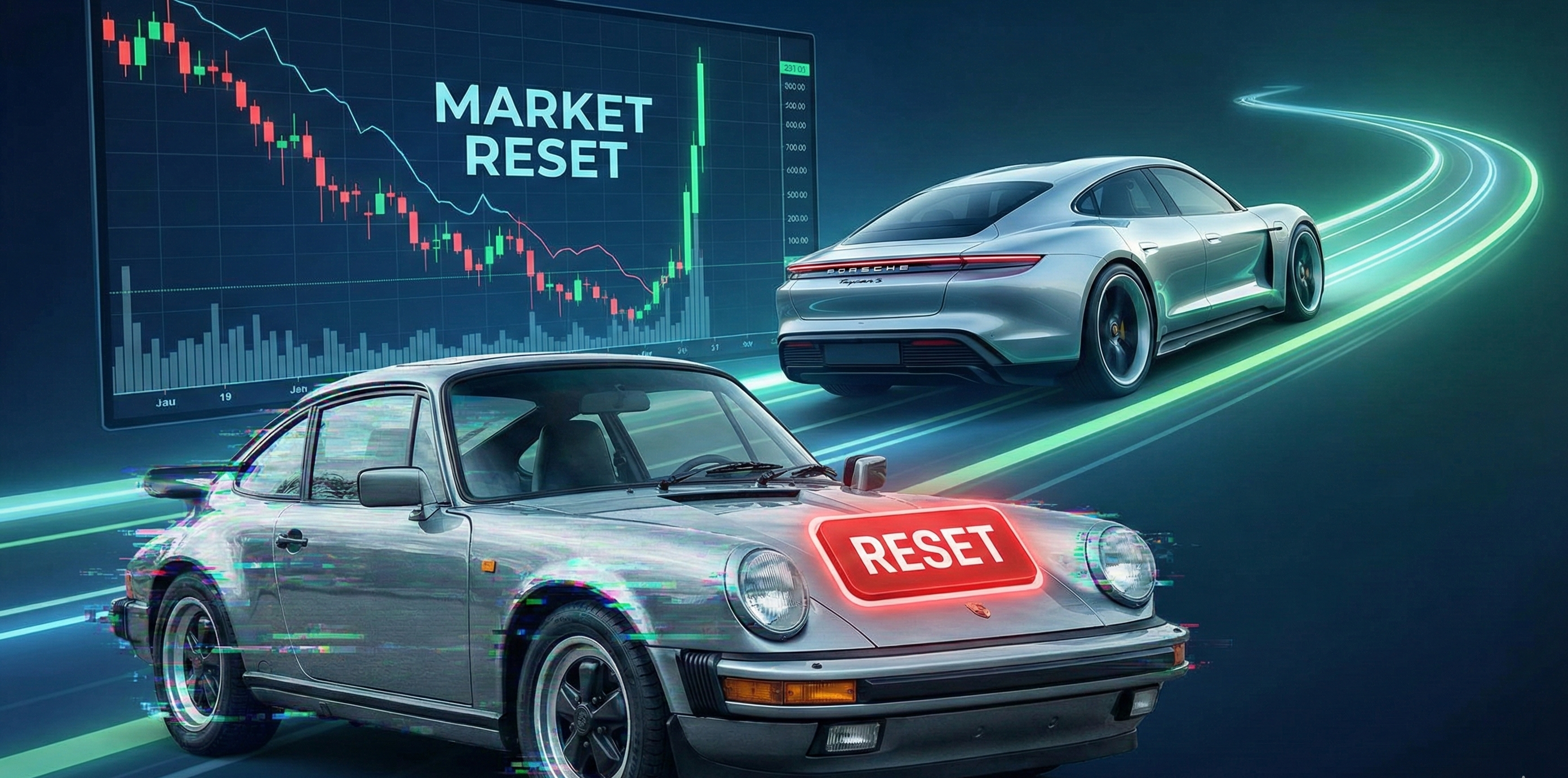
The Porsche Market Is Resetting: Why the Old Model No Longer Works
January 15, 2026
Who this article is for
This analysis is for Porsche buyers, collectors, OPC insiders, and enthusiasts who want a clear, unfiltered understanding of Porsche’s retail and strategic position heading into 2025, beyond press releases and corporate optimism.
What Happens at Porsche After Christmas?
In the retail world of Porsche, the Christmas break is brutally short.
No sooner has the Christmas pudding settled and year-end bonuses been reluctantly approved than Official Porsche Centres (OPCs) face a familiar spectre: a blank sales board, higher targets, and zero goodwill for the physical and emotional cost of December delivery pushes.
This cycle frames exactly what Porsche retailers face entering 2025, only now against a backdrop of industry instability, EV misalignment, and growing VW Group distress.
How December Porsche Deliveries Really Get Done
If you were one of the nearly 1,000 UK buyers who received a new Porsche in December, it’s worth understanding what happened behind the scenes.
Key operational challenges OPCs faced:
- Vehicle logistics uncertainty
Porsche shares shipping capacity with the wider Volkswagen Group, meaning brand prioritisation can delay final deliveries.
- Dealer-funded transport solutions
Some franchisees paid for private vehicle transport directly from ports, an exceptional and costly move to avoid disappointing customers.
- Finance disruption
With VW Financial Services APRs elevated, many customersare funded externally. December volumes plus lender holidays caused delayed payouts that sales teams personally navigated to protect customer handovers.
At theporschebuyer.com, working closely with OPCs during this period revealed something genuinely rare in modern retail: dealers prioritising customer delivery over commercial self- preservation.
Why Porsche Forecasting Used to Be Ruthless (and Why That Matters)
Historically, Porsche treated forecasting as sacred.
At Porsche, delivering one car over target could land a sales manager in as much trouble as delivering one under.
This rigid discipline controlled:
- Supply
- Residual values
- Brand exclusivity
In 2013, UK new-car targets were met by October, and Porsche stopped selling new cars for the rest of the year, forcing dealers to survive on used inventory.
That philosophy protected the brand.
What Changed in 2024?
2024 told a very different story.
- UK was leaned on to absorb global shortfalls.
- Discounting previously unthinkable was quietly allowed.
- Porsche AG supported dealers by looking the other way on “monster deals.”
- A long-standing Porsche employee summed it up perfectly:
“I can’t believe we are doing deals at Christmas.”
Some customers benefited from offers that would have been impossible even two years ago.
What Does This Mean for Porsche as a Brand?
Time will tell, but the warning signs are real.
Why 2025 could be Porsche’s toughest year since the early 1GG0s:
- China dealership closures
Porsche has closed roughly one-third of its Chinese retail network, an extraordinary move for a brand that viewed China as its growth engine for over a decade.
- EV economics gap
Porsche leadership has openly acknowledged it cannot compete with Chinese EV manufacturers, who can build cars 42–48% cheaper due to scale.
- VW Group financial strain
Porsche is now expected to restructure financially, a move I actually view as long overdue and positive.
Is Porsche’s EV Strategy Misaligned With Its Customers?
Let’s be frank.
Despite the technical excellence of Macan EV and Taycan, enthusiast sentiment remains largely opposed.
I can’t recall a single call from a Porsche customer celebrating the electrification of the entire range.
The market has spoken, and finally, the Group appears to be listening.
Porsche sits on exceptional alternative-powertrain engineering assets, and I believe 2025 marks a pivot away from blind EV acceleration toward strategic differentiation where Porsche can once again out-engineer rather than out-scale.
Why Porsche’s Identity Must Diverge From VW Group
Increasingly, customers want Porsche to step away from the wider VW Group strategy and reassert its own identity.
That means:
- Fewer compromises
- Less volume chasing
- More mechanical authenticity
- Predictable residual values
Unpredictability is kryptonite to Porsche ownership, and it has crept in.
FAǪ: Porsche Market Outlook 2025
Is Porsche in trouble financially?
Not existentially, but 2025 represents one of its most challenging transitions in decades.
Are Porsche dealers discounting more?
Yes, selectively. Deals seen in late 2024 would have been unthinkable previously.
Is Porsche stepping back from EVs?
Not abandoning them but recalibrating strategy due to market reality and competition.
Why is China such a concern?
China was Porsche’s primary growth thesis. Network contraction is highly significant.
Should buyers be worried about residual values?
Short-term volatility exists, but long-term discipline appears to be returning.
Key Takeaways (Snippet-Optimized)
- Porsche dealers delivered record December volumes at personal and financial cost
- Forecast discipline has softened, risking long-term brand strength
- Aggressive discounting signals structural pressure, not generosity
- China exposure and EV economics pose real challenges
- 2025 may force Porsche back toward its core values, and that may be its saving grace